Introduction: “Subatomic Particle Simulations” are simulations of protons, neutrons, and electrons to imitate an single atom along with nucleus dynamics and electrons distributed around it. Molecular dynamics (MD) and/or Monte Carlo (MC) algorithms were applied to protons, neutrons, and electrons that simulate nucleus formation and electrons around it.
To calculate interactions (potential and force acting ) between protons, neutrons, and electrons, pseudo potentials were developed and parameterized to have stable nucleus at center and electrons distributed around it, giving stable individual full atom imitation. These pseudo potentials are called as “Subatomic Interaction Potentials (SIP)“. SIP is an alternative to Coulomb potentials, where applied Coulomb potentials to protons, neutrons, and electrons gives atom deformation and unstable atom in “Subatomic Particle Simulations”. For more information on “Subatomic Interaction Potentials (SIP)” visit this page.
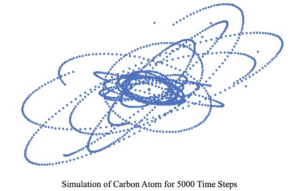
Molecular Dynamics (MD) Algorithms on “Subatomic Particle Simulations”: MD algorithms applied to subatomic particles (protons, neutrons, and electrons) gives classical simulations of “Subatomic Particles Simulations”. Example of trajectories of subatomic particles in a Carbon atom is shown in the following figure.
Stable Uranium Atom Simulation with Protons, Neutrons and Electrons in it
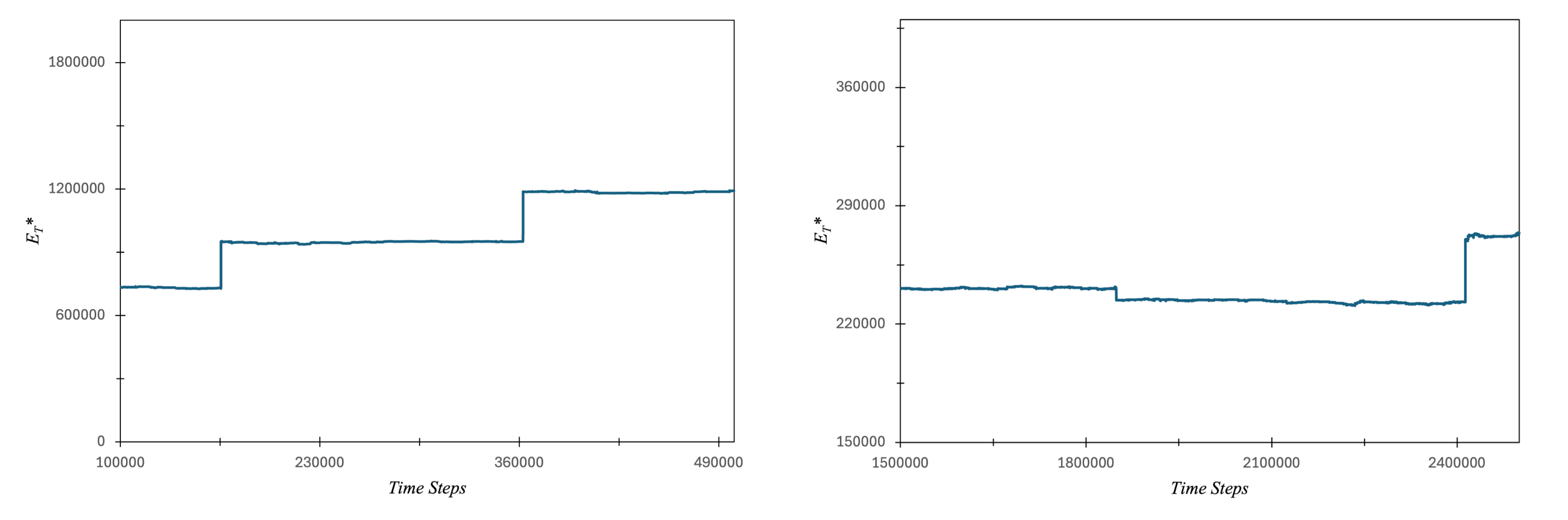
Simulations of Hydrogen atom, Carbon atom, Fluorine atom, Magnesium atom, and Chlorine atom were conducted and preprint article can be found here [1]. 1. Venkatesan, S. Quantized Atomic Energies Emerge from Classical Subatomic Particle Simulations: A Unified Explanation for Atomic Emission Spectra from Classical Mechanics. Preprints2026, 2026040891. https://doi.org/10.20944/preprints202604.0891.v1 Discovery of Quantum Effects enclosed in Classical Mechanics: Investigation of total energy of an individual atom over time shows groundbreaking discovery of quantized energies having discrete values over time with step changes in the graph as shown in below figure [1]. This discovery shows that quantization property of atom’s energies were already enclosed in classical mechanics explaining atomic spectral lines. Research article on this discovery can be found here [1].
Monte Carlo (MC) Algorithms in “Subatomic Particle Simulations”: MC algorithms applied to protons, neutrons, and electrons gives classical and quantum simulations in “Subatomic Particle Simulations”.
Monte Carlo simulations was developed by placing randomly protons, neutrons and electrons around the box for a Carbon atom. Atom formation was captured by having protons and neutrons in the nucleus and electrons was distributed randomly around it.
No Need of Super Computers for “Subatomic Particle Simulations”: Unlike quantum simulations like DFT calculations or ab-initio MD/MC quantum simulations, “Subatomic Particle Simulations” doesn’t require super computers to run the simulations, as subatomic particles interactions were calculated with simple pseudo potentials similar to Lennard-Jones potentials for atoms. For example to run DFT calculations for a molecule, which needs super computers and longer times, same simulation in “Subatomic Particle Simulations” need a personal computer/laptop would do the same job.