Subatomic Particle Simulations
Molecular dynamics and Monte Carlo algorithms were applied to protons, neutrons, and electrons to simulate an individual atom, having nucleus at center and electrons were distributed around it.

Discovery of Quantum Effects enclosed in Classical Mechanics.
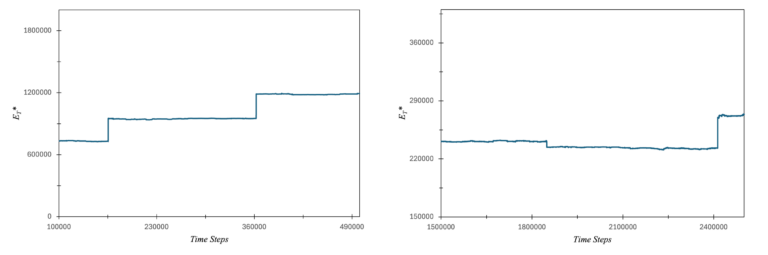
Investigation of individual atom’s total energies reveals quantized discrete energy values property by having step changes in energy profiles explaining atomic spectral lines.

A new perspective on looking into subatomic particles was presented. Protons, electrons, and neutrons are treated as conventional particles in inside an atom, exhibiting attraction and repulsion between them, akin to the way atoms attract and repel each other in atomic simulations. This new approach leads to development of pseudo potentials for subatomic particles to model the subatomic particle interactions in an individual atom.

Sahasrara Research
Sahasrara Research is a open-source initiative founded by Dr V Shanmuga Sundaram PhD, that develops “Subatomic Particle Simulations”. Simulation codes of “Subatomic Particle Simulations” were made open-source and people are encouraged to improve or develop further and we will update in this website. Please visit “About Sahasrara Research” page for more information. To download simulation codes, please visit “Download Codes” page. Visit “Publications Page” to know more about publications made by Sahasrara Research.
–
1. Subatomic Particles Simulations:
Molecular Dynamics (MD) and/or Monte Carlo algorithms were applied to protons, neutrons, and electrons to form nucleus dynamics at center and electrons distributed around them. These simulations are named as “Subatomic Particle Simulations”. To know more about “Subatomic Particle Simulations”, please visit Subatomic Particle Simulations page.
a. To know more about MD algorithms applied to protons, neutrons, and electrons, please visit MD Algorithms in Subatomic Particle Simulations page.
b. To know more about MC algorithms applied to protons, neutrons, and electrons, please visit MC Algorithms in Subatomic Particle Simulations page.
–
2. Subatomic Interaction Potentials (SIP):
Pseudo potentials were developed, an alternative to Coulomb Potentials, with invention of new theory that protons and electrons repel at femtometer scale in inside the atom. These pseudo potentials (also known as “Subatomic Interaction Potentials (SIP)”) gives stable atom with nucleus dynamics for MD and/or MC algorithms applied in “Subatomic Particle Simulations”. To know more about “Subatomic Interaction Potentials (SIP)”, visit Subatomic Interaction Potentials page.
–
3. Groundbreaking Discovery of Energy Quantization Property enclosed in Classical Mechanics:
Investigation of Carbon atom total energies over time leads to discovery of its energies which are quantized discrete values in classical mechanics as shown in following figure. Similar property was found in other atoms of Fluorine Atom, Magnesium atom, and Chlorine atom. To know more about this discovery read this preprint.
4. Publications of Sahasrara Research:
Sahasrara Research made series of publications in peer-review journals, preprints and published books on “Subatomic Particle Simulations” by its founder Dr. V. Shanmuga Sundaram. Please visit “Publications page” for more information.
–
5. Open-Source Simulation Codes:
As an open-source initiative, Sahasrara Research made available to download simulation codes of “Subatomic Particle Simulations”. Please visit “Download Codes Page” to explore and download the codes. To include your contributions, please contact us.
–
6. Simulation Videos:
Please visit “Simulation Videos Page” to see “Subatomic Particle Simulations” videos of MD and/or MC algorithms applied on protons, neutrons, and electrons.
–
7. Contact Us:
Please contact us for more information on “Subatomic Particle Simulations” and include your contributions in the simulation codes.
–
8. Donate Now:
As a open-source initiative, Sahasrara Research welcomes donations from people who still believe, to make this world a better place. Please visit “Donate Now” page to donate now. Thank you in advance.